


An advanced biography of Ada Lovelace focused on imagination, mathematics, Babbage's Analytical Engine, symbolic computation, and the limits of machine intelligence.
Читай текст у контексті й натискай підсвічені слова, щоб відкрити переклад, транскрипцію та дії зі словником.
Vocabulary:28(✓0+0-28)
knownlearningnew
Ada Lovelace is often called the first computer programmer, but the phrase can hide the most interesting part of her story. She did not work with a computer . She never saw Charles Babbage's Analytical Engine fully built. What she did was more unusual: she looked at a machine that and imagined a future in which machines could follow symbols, not only numbers.
Augusta Ada Byron was born in London on December 10, 1815. Her father was the poet Lord Byron, famous, , and often absent. Her mother, Anne Isabella Milbanke, valued mathematics and . After the marriage , Ada was raised away from Byron's influence. Her education was shaped partly by fear that poetic imagination might become dangerous if it was not controlled by logic.
That plan did not remove imagination from Ada. It gave her imagination a different language. She studied mathematics, music, languages, and science, and she became fascinated by the relationship between pattern and meaning. Later she called her own method . The phrase matters because it : Ada did not see mathematics as cold machinery or imagination as escape. She wanted them to work together.
In 1833, when she was seventeen, Ada met Charles Babbage at a party. Babbage was already known for his work on s. He showed visitors a small working part of his Difference Engine, a machine designed to produce mathematical tables more reliably than human calculators. Ada was . Others saw polished brass and clever wheels. She saw a promise: a machine could become a partner in thought.
Babbage's more idea was the Analytical Engine. Unlike the Difference Engine, it was not meant to perform only one kind of calculation. It was designed as a machine, with memory, operations, and instructions. The engine would use , an idea borrowed from automated looms, to control what it did. In the nineteenth century, this was a from arithmetic tool to programmable system.
Ada's major opportunity came through . In 1842, the Italian engineer Luigi Menabrea published an article in French explaining Babbage's Analytical Engine. Ada translated the article into English, but she did much more than translate. Her notes became longer than the original article. In them, she explained the machine, corrected misunderstandings, its possibilities, and gave readers a clearer sense of what kind of invention Babbage was proposing.
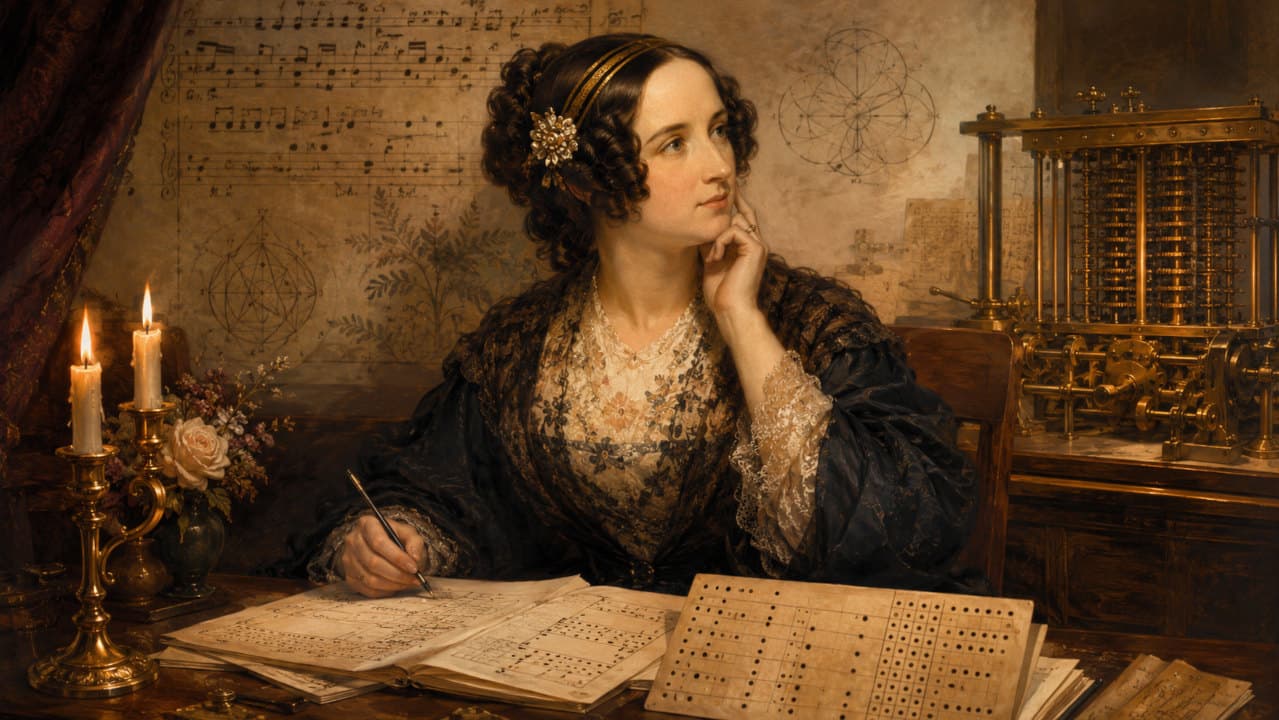
The most famous part is now called Note G. There Ada described how the Analytical Engine could calculate Bernoulli numbers through a . Modern readers often describe this as the first published computer program. The claim has been debated, partly because Babbage also wrote procedures for his machines. Still, Ada's published table was unusually clear, , and connected to a broader explanation of programmable computation.
Her deeper was not only that a machine could calculate. Many people already understood calculation. Ada saw that numbers could represent other things if a machine was built to according to rules. She wrote that the engine might act upon things besides number, if those things could be expressed through . In one famous example, she imagined that such a machine might compose complex music.
This idea sounds ordinary now because computers handle images, music, language, games, and scientific models every day. In Ada's world, it was extraordinary. Machines were usually understood as tools for physical labor or numerical calculation. Ada imagined a symbolic machine before the technology existed to prove her right. Her vision was not magic. It was built from mathematics, music, and careful reading of Babbage's design.
Ada was also . She did not claim that the Analytical Engine could think for itself. In her notes, she argued that the machine had no power to anything; it could do only what people knew how to order it to perform. More than a century later, Alan Turing would call this Lady Lovelace's when discussing whether machines could be intelligent. Her caution remains useful because it separates impressive output from .
This makes her feel unexpectedly contemporary. Modern people argue about artificial intelligence, creativity, automation, and whether a machine can truly understand what it produces. Ada did not answer those questions for us, but she gave them an early shape. She could imagine machines doing remarkable symbolic work while still asking where the human idea entered the process. That balance of wonder and restraint is one reason her notes still feel alive.
Her life outside the notes was complicated. She married William King in 1835 and later became Countess of Lovelace. She moved in scientific and aristocratic circles, but her health was often fragile, and her ambitions had to pass through a society that did not easily welcome women as mathematical authorities. She worked intensely, sometimes under pressure, and her correspondence with Babbage shows both collaboration and tension.
It is also important not to turn Ada into a lonely miracle. She depended on tutors, books, correspondence, and Babbage's machine designs. At the same time, those networks did not erase her own intellectual risk. She had to read across languages, translate technical ideas, and imagine uses that went beyond the inventor's immediate examples. Her achievement sits in that difficult space between collaboration and originality.
Ada died of cancer on November 27, 1852, when she was only thirty-six. The Analytical Engine was never completed in her lifetime. Her notes did not immediately create a computing industry, and for many decades her name rather than a public symbol. Later generations returned to her work because the world finally built machines that made her imagination easier to recognize.
Her should be handled with care. Calling her the first programmer is powerful, but it can become too small if it only means one table of operations. Ada matters because she saw computation as more than arithmetic. She understood that a machine could process symbols, follow instructions, and participate in creative systems designed by human minds. That is why her story belongs not only to computer history, but to the history of imagination itself.
Ada Lovelace did not invent the modern computer alone. No serious history needs that myth. Babbage designed the engine, Menabrea explained it, engineers and mathematicians shaped the world around it, and later scientists built actual computers. Ada's contribution was different: she saw the outline of a new before the tool existed. She reminds us that technology begins not only with metal and circuits, but with someone willing to ask what a machine might mean.
Обговорення
щоб коментувати, лайкати відповіді та скаржитися на коментарі.