



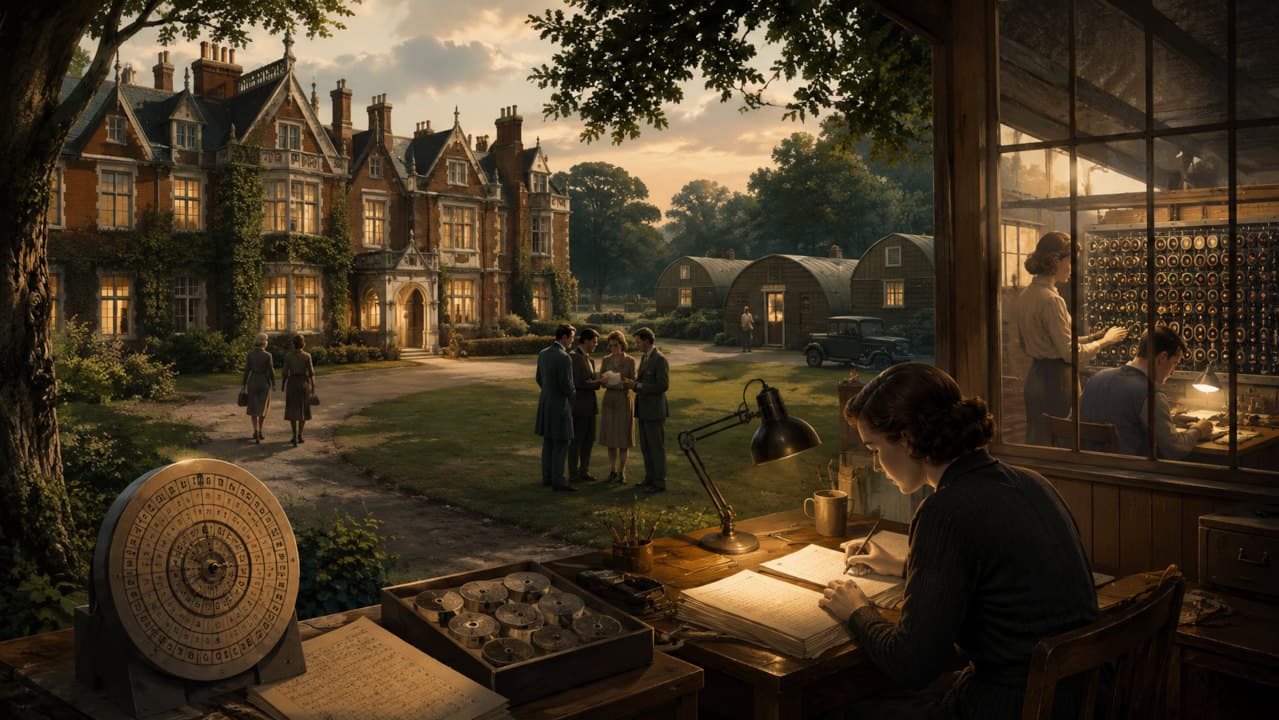
An intermediate place profile about Bletchley Park, codebreaking, secrecy, Enigma, Tunny, Colossus, and the hidden teamwork behind wartime intelligence.
Читай текст у контексті й натискай підсвічені слова, щоб відкрити переклад, транскрипцію та дії зі словником.
Vocabulary:17(✓0+0-17)
knownlearningnew
Bletchley Park looks like a , not a place that could change a war. It sits in Buckinghamshire, north of London. During the Second World War, this quiet became the main British centre for .
The work was secret. Thousands of people came to the site, but many could not explain their jobs even to family members. , s, mathematicians, engineers, radio operators, and military staff worked in huts and offices. The place was less like one genius at a desk and more like a hidden factory of .
The problem was urgent. German forces sent many messages in code. Some were with the Enigma machine. Others used more complex systems, including Tunny. If the Allies could read enough messages, they could understand plans, routes, threats, and movements before it was too late.
Codebreaking did not mean guessing one password. It meant finding patterns inside huge numbers of possible . Machines helped, but people still had , test ideas, check results, and turn broken messages into useful reports. Speed mattered because a message could lose value quickly.
Alan Turing is the most famous name connected with Bletchley Park, and his work on the Bombe machine was important. But the larger story includes many people. Gordon Welchman, Dilly Knox, Joan Clarke, Bill Tutte, Tommy Flowers, and thousands of lesser-known workers all formed part of the system.
This is one reason Bletchley Park changed the world. It joined mathematics, language, engineering, administration, and military knowledge in one place. A crossword skill, a German phrase, an electrical , or a careful filing system could all matter.
The site also changed the meaning of office work. Some people copied signals, some ran machines, some translated, some sorted paper, and some carried messages from one hut to another. None of those jobs looked heroic alone. Together, they created a system that could turn noise into knowledge.
Bletchley Park depended on discipline as much as brilliance. Workers followed strict routines because one small error could damage a chain of work. A message had to be intercepted, recorded, attacked, checked, translated, summarized, and sent to the right people. The process was technical, but it was also deeply human.
The intelligence from Bletchley was known as Ultra. It helped Allied leaders make better decisions, especially when messages revealed s or plans. Historians still debate exactly how much the work shortened the war, but there is no serious doubt that it gave the Allies important information.
Bletchley Park also matters because of computing. The Colossus machines, built to help attack the Lorenz/Tunny , were among the first electronic digital computers. They were not personal computers, and they were built for a narrow wartime purpose. Still, they showed how electronics could at high speed.
This matters because modern life now depends on fast information processing. Banks, hospitals, weather systems, maps, phones, and the internet all rely on machines finding patterns in data. Bletchley Park did not create that world alone, but it belongs to the early story of how electronic computing became thinkable.
The people at Bletchley worked under pressure. A mistake could waste time. A delay could mean lost ships, failed missions, or more danger for soldiers and civilians. Yet the work often looked ordinary from the outside: paper, tea, cold huts, , and quiet concentration.
The place also complicates the idea of a hero. Alan Turing matters, but the site was not only Turing's story. Women did much of the operational work. Polish codebreakers had made crucial earlier breakthroughs on Enigma. Engineers, translators, messengers, and managers all shaped the result.
Secrecy shaped the place for decades after the war. Many workers did not talk publicly about what they had done. Some achievements were hidden for a long time, so arrived slowly. The silence protected secrets, but it also made many contributions hard to see.
The site now works as a museum and memorial. Visitors can see huts, machines, documents, and stories of the people who worked there. The visit changes the old image of codebreaking. It was not only dramatic moments and brilliant flashes. It was routine, discipline, cooperation, and patient thinking.
Bletchley Park changed the modern digital world because it turned secrets into knowledge. It helped show that information could be a battlefield, and that machines could help people read patterns too large for the human mind alone. A quiet house became part of the history of war, intelligence, modern security, and computing.
Обговорення
щоб коментувати, лайкати відповіді та скаржитися на коментарі.