An extended article about Sea Shepherd, its direct-action roots, major campaigns, achievements, and controversies.
Основний текст
Читай текст у контексті й натискай підсвічені слова, щоб відкрити переклад, транскрипцію та дії зі словником.
Vocabulary:17(✓0+0-17)
knownlearningnew
Sea began with a simple argument: if laws exist to protect the ocean, somebody has to be willing to help them. The organization was founded in 1977 by Paul Watson, a Canadian activist who had worked with Greenpeace but wanted a more style of conservation. He believed that protest alone was not enough when whaling ships, illegal fishing fleets, and poachers were already at sea.
From the start, Sea Shepherd presented itself not as a research group or a lobbying office, but as a fleet. Its ships would go to the places where marine animals were being killed and try to stop the killing directly.
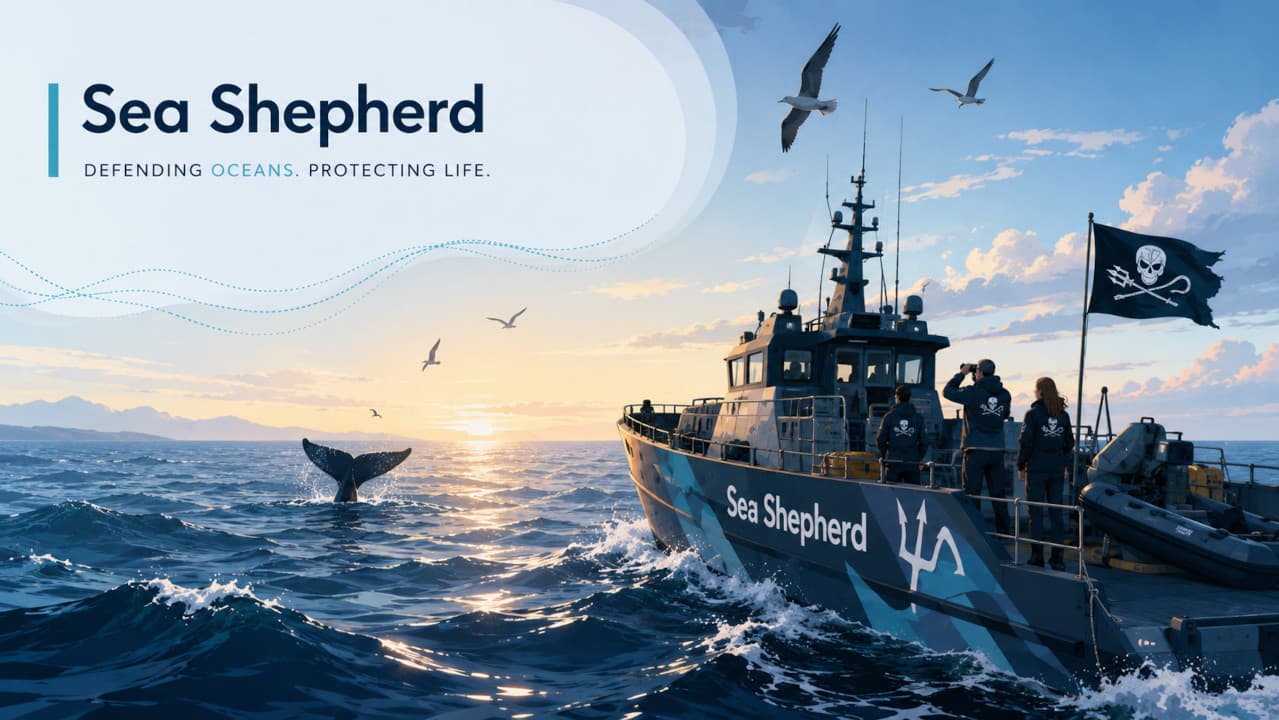
That idea made Sea Shepherd famous, controversial, and difficult to ignore. Its black flag, marked with a skull, a shepherd’s staff, and a trident, looked more like a pirate symbol than a traditional charity logo. The image was deliberate. Sea Shepherd wanted to signal that the ocean was not an empty space where companies could act without consequences.
Its crews filmed what they saw, placed themselves between hunters and animals, cut illegal nets, and sometimes used that critics called too aggressive. Supporters argued that the real violence was the destruction of wildlife and habitats.
The early campaigns focused strongly on whales. In 1979, Sea Shepherd targeted the Sierra, a notorious whaling vessel that had been accused of operating outside international rules. The confrontation became part of the group’s origin story and shaped its reputation for high-risk action. Over the following decades, Sea Shepherd sent ships to the North Atlantic, the Southern Ocean, and other whaling areas.
Its crews tried to hunts, document violations, and push governments to take enforcement more seriously. The group’s Antarctic whale defense campaigns later became widely known through the television series Whale Wars, which turned a remote conservation conflict into a public drama.
Sea Shepherd’s approach also changed as the ocean crisis changed. Whaling remained important, but illegal, unreported, and fishing became one of its central targets. This kind of fishing is hard to fight because it often happens far from shore, across borders, and in places where local authorities have limited ships, fuel, or equipment.
Sea Shepherd began to work more often with governments, coast guards, and park authorities. Instead of only confronting vessels independently, its crews increasingly provided ships, , evidence, and experienced teams to help official enforcement.
One of the clearest examples was Operation Icefish, launched in 2014 to vessels accused of illegally fishing for Antarctic and Patagonian toothfish. These fish are often sold as Chilean sea bass and can bring high prices, which makes them attractive to . Sea Shepherd tracked the Thunder, one of the most wanted illegal fishing vessels in the world, for more than three months.
The chase ended when the ship sank in 2015, and evidence recovered by Sea Shepherd helped legal cases against people connected to the vessel. For supporters, the campaign showed that a small NGO could expose activity that governments had struggled to stop.
Another major area of work has been the protection of the vaquita, a small porpoise found only in Mexico’s Upper Gulf of California. The vaquita has been pushed close to extinction mainly because it becomes in illegal gillnets set for totoaba, a fish whose swim bladder is trafficked on the .
Sea Shepherd has worked with the Mexican Navy to remove nets from and reduce the danger to the remaining animals. The campaign is difficult and tense because it touches local fishing communities, organized crime, poverty, and international demand for wildlife products. It shows that ocean protection is rarely just about animals; it is also about economics and enforcement.
Sea Shepherd has also operated in the Galápagos, West Africa, the Mediterranean, and other regions where marine reserves exist on paper but need practical defense. In some places, the organization helps protected areas. In others, it documents , shark finning, octopus traps, or destructive gear.
The exact methods vary, but the pattern is similar: put a ship in the water, gather evidence, remove illegal equipment when authorized, and make hidden damage visible. This practical presence is one reason the group has survived for so long. It turns abstract environmental language into images of nets, hooks, animals, crews, and law enforcement.
The organization’s achievements are not only measured by dramatic confrontations. Sea Shepherd has helped remove thousands of illegal nets, supported arrests and inspections, drawn attention to underreported species, and made illegal fishing a public issue. Its whale defense campaigns claim to have saved thousands of whales from harpoons in the Southern Ocean.
Its anti-poaching work has helped governments patrol areas they could not easily cover alone. Perhaps just as important, Sea Shepherd changed the emotional language of marine conservation. It made the ocean feel like a place where ordinary people could take a side, volunteer, donate, document, and pressure authorities to act.
At the same time, Sea Shepherd has always attracted criticism. Some governments, fishing groups, and commentators have accused it of dangerous tactics, publicity-driven campaigns, or simplifying complex local problems. The organization’s relationship with Paul Watson has also become more complicated over time, especially after internal splits and legal battles around anti-whaling actions.
These controversies matter because conservation work depends on public trust as well as courage. Sea Shepherd’s story is therefore not a simple tale of heroes and villains. It is a case study in what happens when moral urgency meets law, diplomacy, media, and real people trying to make a living from the sea.
That tension may explain why Sea Shepherd remains interesting after nearly five decades. Many environmental groups ask people to sign petitions, reduce plastic, or support policy change. Sea Shepherd asks a sharper question: what should happen when rules are written but not enforced? Its answer has been to put vessels, volunteers, cameras, and legal evidence directly into the conflict. Sometimes that approach creates results.
Sometimes it creates . But it has forced the public to look at parts of the ocean that are usually invisible. It points to long lines, drifting nets, , dead bycatch, and protected areas that exist only if someone is watching.
Today, Sea Shepherd is best understood as a direct-action conservation network rather than a single campaign against one industry. Its work connects whales, dolphins, sharks, rays, turtles, fish, coral reefs, and marine reserves through one central belief: the ocean cannot defend itself. Whether one agrees with every tactic or not, the organization has helped make enforcement a central part of ocean protection.
It reminds learners of English, too, that environmental language is often built from action words: to patrol, to expose, to intercept, to remove, to defend. In Sea Shepherd’s story, those verbs are not decoration. They are the method.
Вправи
Перевірте розуміння тексту, ключову лексику та зміст уроку після читання.
Після перегляду визнач, чи правильне твердження
Визнач, чи твердження відповідають статті.
Щоб виконувати завдання, увійдіть в акаунт.
Вибери правильний варіант відповіді
Вибери правильну відповідь за змістом статті.
Щоб виконувати завдання, увійдіть в акаунт.
Обговорення
щоб коментувати, лайкати відповіді та скаржитися на коментарі.






Обговорення
щоб коментувати, лайкати відповіді та скаржитися на коментарі.