


A narrative history of how Venice turned an unstable lagoon into a maritime system, a cultural image, and a modern struggle between protection and daily life.
Читай текст у контексті й натискай підсвічені слова, щоб відкрити переклад, транскрипцію та дії зі словником.
Vocabulary:18(✓0+0-18)
knownlearningnew
Before a marble palace could rise in Venice, builders had to begin with wood. They drove timber piles deep into wet ground, laid heavy boards across them, and created a strong enough to carry stone. The method sounds unlikely, but the city itself began as an unlikely answer to a difficult landscape.
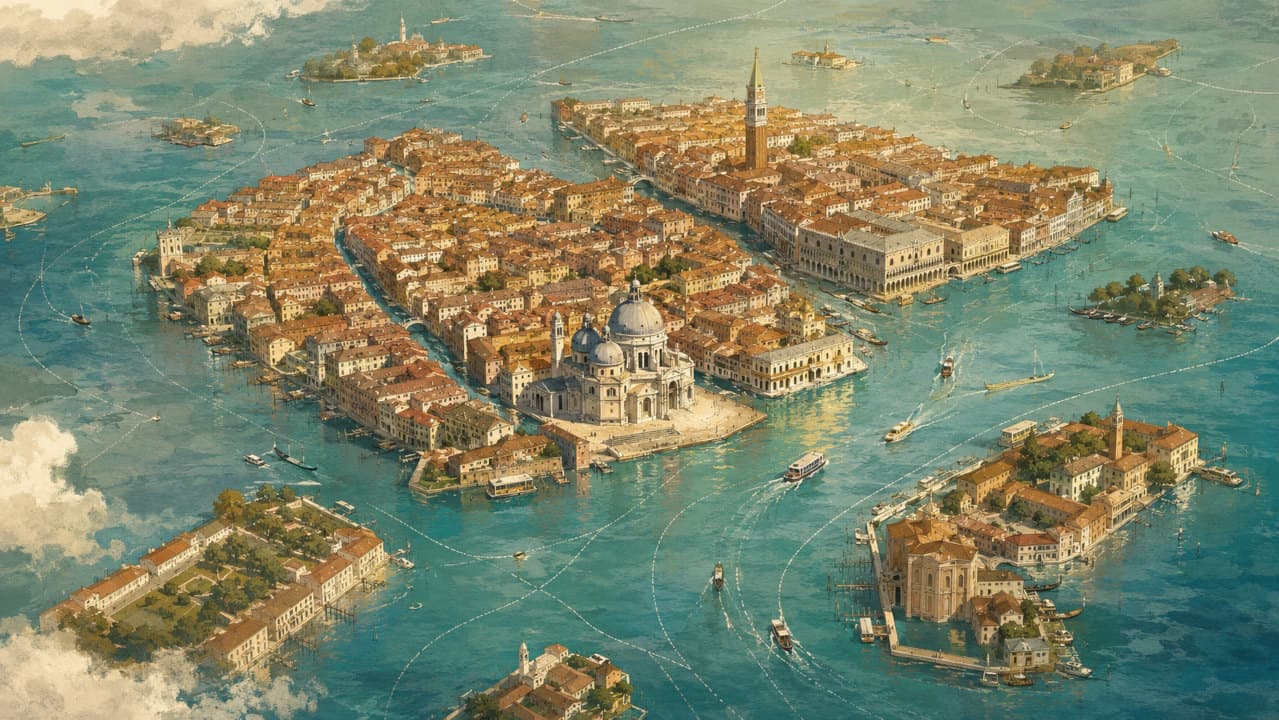
Venice grew on small islands inside a shallow at the northern end of the Adriatic Sea. Water separated it from armies on the mainland, yet opened routes toward other ports. The obstacle became protection, road, marketplace, and eventually political power.
A City That Could Not Stand Still
The early settlements were built among islands, channels, salt marshes, and shifting . A could change the depth of a route within hours. s had to read the water, move goods by boat, strengthen banks, and canals that worked as the city's streets.
This geography shaped everyday life. Stone, grain, drinking water, letters, and rubbish all moved differently in a city without normal roads. Venice did not defeat the lagoon and replace it with dry land. It learned to function inside a living system that constantly needed attention.
Water also imposed discipline on growth. A new building, a deeper channel, or a changed shoreline could affect movement elsewhere in the lagoon. Private construction therefore depended on shared waterways and shared maintenance. The city became dense not because space was easy to use, but because every usable piece had to connect with the whole.
The Republic That Read the Sea
By the Middle Ages, Venice had become a with interests far beyond its islands. Its ships travelled along each major linking Western Europe with the Byzantine world and the eastern Mediterranean. Geography had become strategy.
A successful needed more than courage. He needed information about prices, storms, wars, and foreign rulers. He needed credit, contracts, sailors, insurance, a , and partners who could be trusted when he was far from home. Every was also a network of promises.
Venetian institutions made this dangerous trade more predictable. Courts handled commercial disputes, officials inspected goods, and diplomats reported from foreign capitals. was not separate from business: a treaty or a reliable message could protect ships as effectively as weapons.
Information had to arrive before an opportunity disappeared. Reports about harvests, conflict, prices, and shipping conditions helped officials and traders decide where to send money and vessels. Venice's advantage came partly from turning many separate observations into decisions that could be made across distance.
The Factory Before the Factory Age
At the Arsenale, Venice concentrated , storage, repair, and military preparation in one enormous working area. Timber, rope, sails, metal, and skilled labor moved through an organized sequence. Long before modern assembly lines, the city understood that speed came from coordination.
The Arsenale supported a that protected trade and projected Venetian influence across the sea. But ships were only one part of the system. Maps, laws, money, intelligence, and trained workers turned physical vessels into lasting power.
Trade wealth paid for churches, paintings, printing houses, glass workshops, public ceremonies, and palaces. Venice learned to present power through beauty. Visitors did not see only a port; they saw a carefully designed image of order rising from water.
When the Image Replaces the City
That image still attracts the world, but changes the place it comes to admire. Homes become short-term accommodation, useful shops give way to visitor services, and high costs push everyday life away from the historic centre. UNESCO warns that this transformation threatens the city's cultural and social identity.
A city can look perfectly preserved while becoming a . A real resident needs schools, food shops, repairs, transport, neighbours, and housing they can afford. If those systems disappear, Venice may keep its famous view while losing the community that gives the view meaning.
The Water Has the Final Word
The lagoon also remains physically fragile. High tides, waves from motor boats, erosion, and rising seas increase the danger of and damage buildings from below. Constant maintenance is not a choice added to Venetian life; it is the condition that allows the city to continue.
The MOSE system uses mobile gates at the lagoon entrances. When exceptionally high water threatens, each can rise and temporarily separate the lagoon from the Adriatic. The gates can reduce danger, but they do not remove the need to protect the wider ecosystem or adapt to long-term climate change.
Venice changed the world because it turned a difficult environment into an urban, commercial, and cultural system. Its modern challenge is harder to photograph than a palace: keeping protection, tourism, nature, and ordinary life in balance. The city survived by learning to live with water. Its future depends on remembering that living is the important word.
Обговорення
щоб коментувати, лайкати відповіді та скаржитися на коментарі.