Why American Burgers Became Status Symbols in Korea | MovEng
Проблема з відтворенням?
Якщо YouTube просить увійти, перевірити, що ви не бот, або відео не стартує в плеєрі, відкрий його напряму на YouTube і повернись до вправ після перегляду.
A business and culture deep dive into how American burger chains became premium experiences in South Korea, how chaebols engineered scarcity and hype, and why the model is starting to backfire.
Корисні слова і вирази42(✓0+0-42)knownlearningnew
But, in South Korea, that exact same burger has somehow been transformed into a kind of .
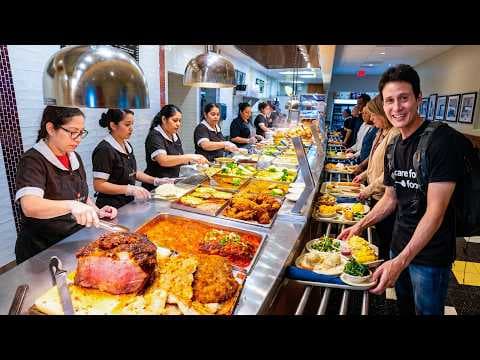
People line up for hours and they take selfies with their burgers to on Instagram.
For some reason, getting a burger at Five Guys has become a for many Koreans.
But, it is definitely interesting that we are seeing this of US fast food franchises and even Canadian franchises like Tim Hortons.
A buys a business, completely guts its expenses to make the cash flow look as profitable as possible, and then sells it a few years later to the next buyer for profit.
Because it's got everything from secret marketing tactics to a slowing local economy to private equity firms and looking to make money in an where it's getting harder and harder to make money elsewhere.
It symbolized a kind of that South Korea was desperately trying to emulate as it rebuilt its war-torn economy.
This is exactly what the Doosan Group, a massive Korean heavy industry conglomerate, to buy the to Burger King.
South Korea was desperate to as a war-torn developing nation and prove to the world that it was a modern first-world economic powerhouse.
To survive this brutal , American brands like McDonald’s and Burger King had to fundamentally change their strategies in Korea.
Instead, they had to .
These brands leaned increasingly into sweet, localized flavor profiles that .
One specific chaebol, the SPC Group, realized that instead of building their own premium burger brand from scratch, they could simply import one of the hottest names in America, Shake Shack.
They were strategically imported, carefully , and engineered by none other than the chaebols, the massive of South Korea.
In case you don’t know how big and powerful a is, Hyundai is a chaebol.
In December 2015, SPC Group officially signed what is known as a .
Under this model, the US headquarters didn’t have to spend a dime or take on to enter South Korea.
SPC committed a multi-million dollar development deal, the kind of that no independent restaurant owner could realistically afford.
They agreed to , including some of the most expensive retail rent in Seoul.
Instead, in July 2016, they staged a massive, highly publicized grand opening of a single in the heart of Gangnam.
Second, because there was only one location in the entire country, SPC effectively .
.
They priced the burger at a premium, rather than fast food.
And the success set off on a that would eventually bring Gordon Ramsay Burger, Five Guys, and even Tim Hortons to the Korean market.
But as we’re about to see with Gordon Ramsay Burger and Tim Hortons, the strategy of squeezing maximum profit out of the Korean consumer is finally starting to .
From a marketing standpoint, absolutely nothing. They almost line for line.
They’re paying for the that they were part of the cultural zeitgeist.
What is the actual for that luxury?
The reality today is that South Korea, much like the rest of the world, is experiencing a severe .
has fallen so sharply that some economic commentators say the mood now feels similar to the period right before the 1997 Asian financial crisis.
Realizing they could no longer sustain a profitable business just selling $25 burgers to a shrinking pool of luxury diners, the conglomerate running the franchise had to .
But, the most outrageous example of this strategy isn't a burger joint.
Despite the and the economic downturn, these massive corporations will likely keep importing famous Western brands into Korea.
Even if it wasn't their original intention, the goal now seems pretty clear. It's a .
If they can manufacture 6 months of insane hype, open a few decently performing flagship stores, and artificially , they can for a massive profit.
And when the chaebols artificially drive up the cost of commercial real estate by opening these giant vanity flagship stores, the independent owners just of their own neighborhoods.
Meanwhile, the traditional middle of the market, the casual, reasonably priced, is being squeezed out of major Korean cities.
Hopefully, you won't be as surprised and you will also remember that what you're witnessing isn't just a trend, it's a reflection of a much larger at work.
Вправи
Перевірте розуміння уроку й потренуйте ключові слова та фрази в контексті.
Після перегляду визнач, чи правильне твердження
Визнач, чи твердження відповідають змісту відео.
Щоб виконувати завдання, увійдіть в акаунт.
Вибери правильний варіант відповіді
Перевір, чи зрозумів головні ідеї відео.
Щоб виконувати завдання, увійдіть в акаунт.
Обговорення
щоб коментувати, лайкати відповіді та скаржитися на коментарі.




Обговорення
щоб коментувати, лайкати відповіді та скаржитися на коментарі.